DIGITAL THREAD SEWING MACHINES
General information
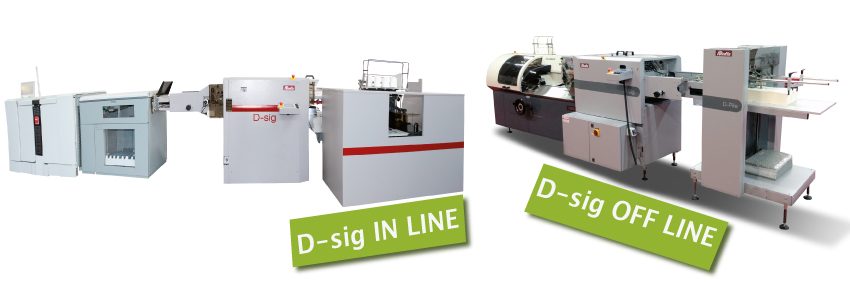
D-SIG IN LINE / D-SIG OFF LINE
This type of binding, which guarantees high resistance, is particularly suitable for volumes with many pages, including dictionaries, textbooks, catalogs, school texts, novels, reading volumes and so on. In other words, this method is ideal for printed products that require a good durability, a certain ease of use and low costs; and intended for those who want a valuable and functional product, therefore not only aesthetic.
The binding procedure called wire-bound paperback is very similar to the milled one. Both provide for printing, folding and intercalation in signatures. The difference is that at this point, in the thread, the signatures are stitched together in order to create a single block.
It differs from the glue paperback by the lack of milling which requires a higher method and higher costs.
The sewing is suitable for publications with a large number of pages and for binding valuable papers that do not absorb glue (e.g. glossy and matte coated paper).
It allows you to open the pages of the book many times and guarantees long life.
Stitched or thread-bound paperback consists of stitching the printouts in the center and then gluing them to the cover. It is made with the use of a thread (linen, cotton, hemp, synthetic) that passes from the outside to the inside of the back from one signature to the next, keeping them joined together to form the book block.
In fact, another technique is used to hold the pages together, which involves the passage of a cotton, hemp, linen or possibly synthetic thread for sewing signatures (groups of pages) in their center. Only then are the pages glued to the cover.
Today it is possible to bind your books or volumes, with significant savings for the customer and with an excellent quality of the final result.
Machines
MAKING MACHINE IN LINE AND OFF LINE
Machines